
Black Swan event explained...
What is a Black Swan event?
INVESTING
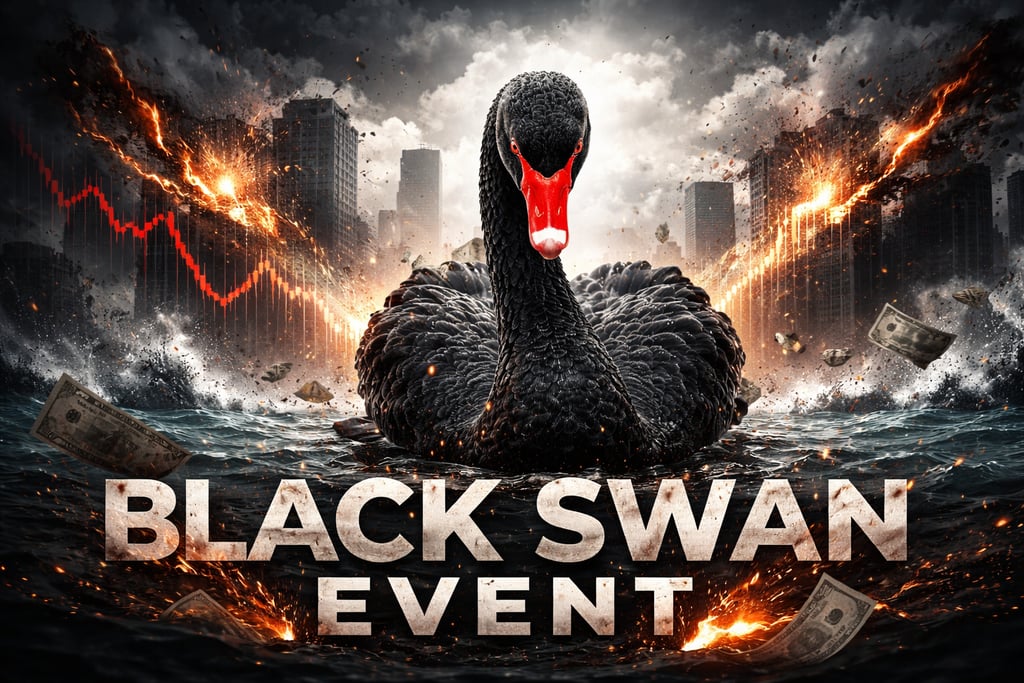
A Black Swan event is a term popularized by Nassim Nicholas Taleb to describe rare, unpredictable events that have a massive impact on economies, markets, or society. These events are almost impossible to foresee using past data, yet after they occur, people often try to explain them as if they were obvious or predictable.
There are three key features of a Black Swan event: it is extremely rare, it carries severe consequences, and it is rationalized in hindsight. In simple terms, it’s something no one sees coming—but once it happens, everyone says, “we should have known.”
History has witnessed several such events. One of the most prominent examples is the 2008 Global Financial Crisis, where the collapse of major financial institutions triggered a global recession. Despite warning signs, very few anticipated the scale of the disaster.
Another example is the COVID-19 Pandemic, which brought the entire world to a standstill. Economies shut down, markets crashed, and everyday life changed overnight—something that was not seriously expected on such a global scale.
Even older events like the September 11 attacks reshaped global politics and security systems in ways that were unimaginable before they occurred.
Black Swan events remind us of a crucial truth: the world is far more uncertain than we assume. For investors and individuals alike, this means preparing for the unexpected—by diversifying, avoiding overconfidence, and building resilience rather than relying solely on predictions.
In the end, it’s not the predictable risks that cause the most damage—but the ones we never see coming.
Help
Questions? Reach out anytime.
reachus@69waystoinvest.com
© 2026. All rights reserved.
Our Team-
Shrinivas B(MBA)
Ravi (MBA)
Prasad (Mcom)