
How the Australian Dollar Beat FDs and Many Index Funds in Just One Year?
Sharp fall of INR against Australian Dollar!!
FIAT MONEYRETURNS
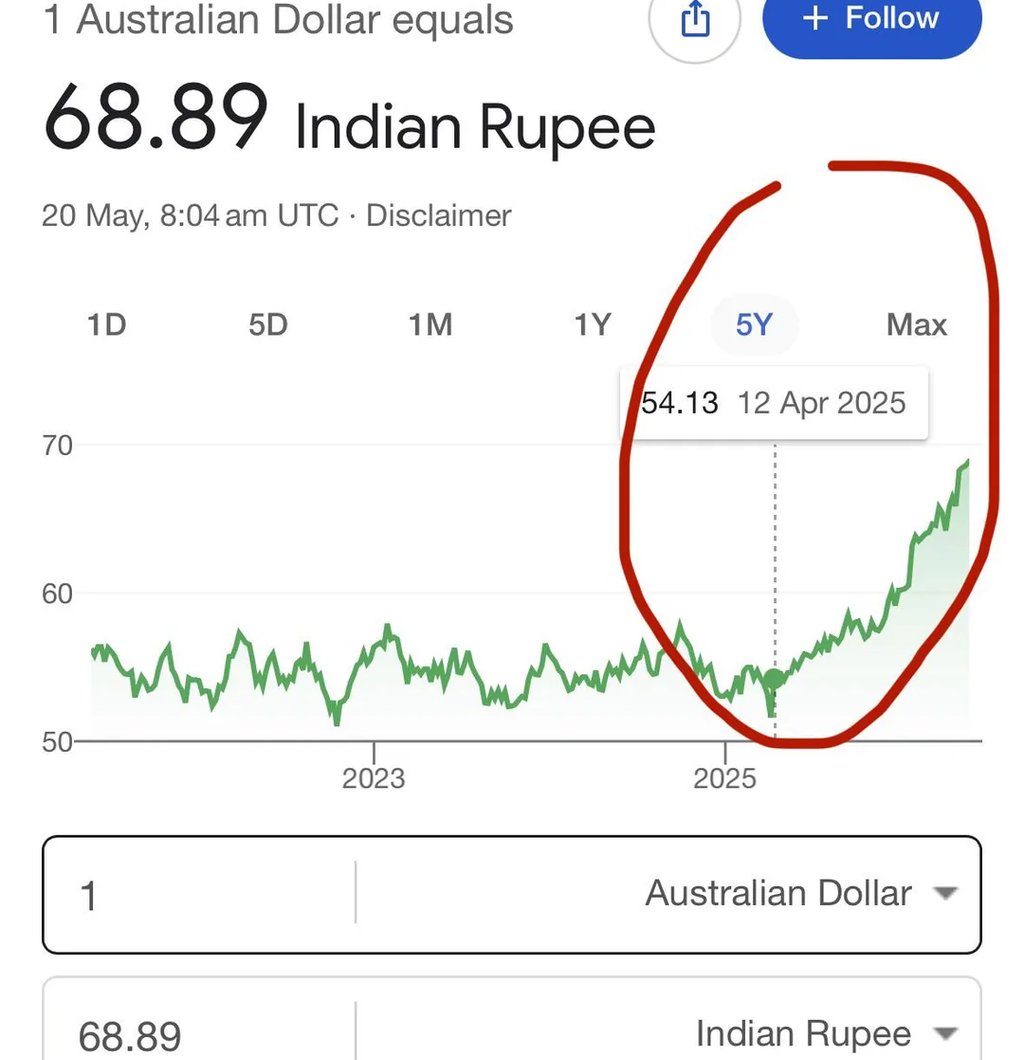
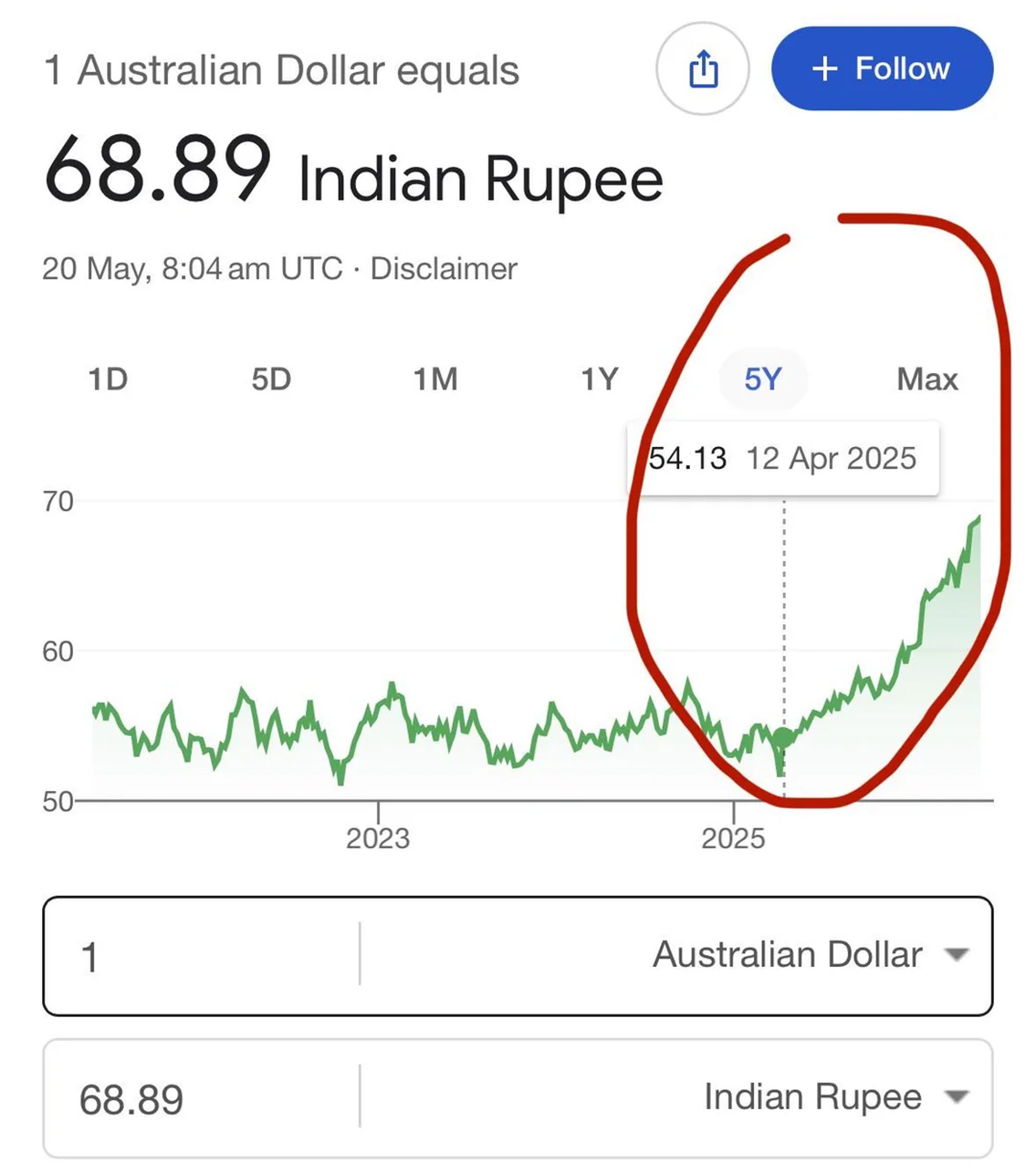
When investors think about wealth creation, they usually focus on stocks, mutual funds, real estate, or fixed deposits. Very few pay attention to currencies. Yet over the past year, the Australian Dollar (AUD) has quietly delivered returns that would make many investors jealous. Against the Indian Rupee (INR), the Australian Dollar appreciated by more than 20%, meaning that an Indian investor holding Australian Dollars saw gains comparable to equity market returns without owning a single share.
To understand this, consider a simple example. Suppose an investor converted ₹10 lakh into Australian Dollars when the exchange rate was around ₹55 per AUD. One year later, with the exchange rate near ₹68 per AUD, the same Australian Dollar holdings would be worth approximately ₹12.3 lakh. The investor would have earned more than ₹2 lakh simply from currency appreciation. No stock picking, no market timing, and no corporate earnings growth were required. In contrast, most fixed deposits generated between 6% and 8% annually, while many broad-market index funds delivered returns that were far lower than the AUD's appreciation against the rupee during the same period.
The obvious question is: why did this happen? The answer lies in the diverging economic fortunes of Australia and India, combined with global capital flows. Australia remains one of the world's largest exporters of commodities such as iron ore, coal, natural gas, and precious metals. As global demand for commodities strengthened and investors sought exposure to resource-rich economies, the Australian Dollar benefited significantly. Commodity currencies often perform well during periods of rising global growth expectations because investors anticipate higher export revenues and stronger economic activity.
At the same time, the Indian Rupee faced its own challenges. India imports a substantial portion of its crude oil requirements, making it vulnerable to rising energy prices. Higher oil prices increase India's import bill and create pressure on the country's trade balance. Foreign investors also periodically pull capital out of emerging markets during periods of global uncertainty, putting additional pressure on currencies like the rupee. While India's long-term economic growth story remains strong, short-term currency movements can diverge significantly from economic growth rates.
Another factor was the difference in interest rate expectations. Global investors continuously move money to countries offering attractive real returns. Australia's monetary policy and economic conditions made Australian assets more attractive during certain periods, increasing demand for the Australian Dollar. Currency markets often react not only to current interest rates but also to future expectations, making exchange rates highly sensitive to economic data and central bank signals.
What makes this story particularly fascinating is that currency appreciation can sometimes outperform traditional investments. A fixed deposit investor earning 7% annually would need nearly three years to match a one-year 20% currency gain. Even investors in broad-market index funds may not have achieved similar returns if equity markets experienced volatility or periods of consolidation. This demonstrates that investment returns are not driven solely by company profits or interest income; currency movements can have a surprisingly large impact on wealth creation.
However, investors should also remember the other side of the story. Currency gains are notoriously difficult to predict and can reverse quickly. Just as the Australian Dollar appreciated sharply against the rupee, it could weaken if commodity prices fall, Australia's economy slows, or global capital flows shift. Unlike businesses that can grow earnings over time, currencies do not inherently create value. They simply reflect the relative strength and attractiveness of one economy versus another.
The lesson for investors is not to abandon stocks or fixed deposits and start speculating on currencies. Rather, it is a reminder that exchange rates are an important and often overlooked component of global investing. Anyone investing in foreign stocks, overseas education, international travel, or global assets is already exposed to currency risk and opportunity. The remarkable rise of the Australian Dollar against the Indian Rupee over the past year shows that sometimes the biggest winners in finance are not companies or stock indices—but currencies quietly moving in the background.
Help
Questions? Reach out anytime.
reachus@69waystoinvest.com
© 2026. All rights reserved.
Our Team-
Shrinivas B(MBA)
Ravi (MBA)
Prasad (Mcom)