
MOAT explained...
What is MOAT in a business?
INVESTING
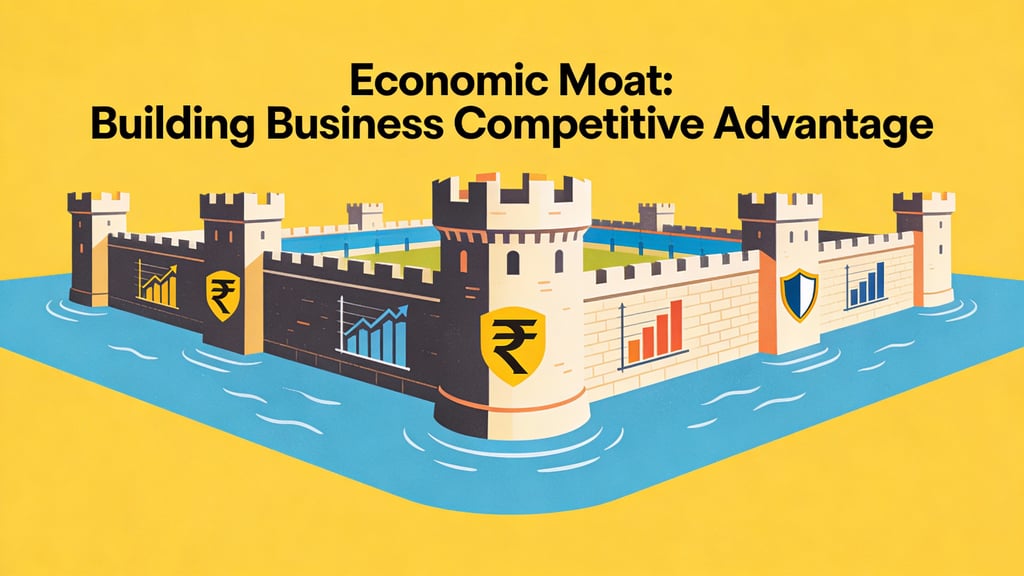
A moat in business is the protective edge that keeps a company stronger, safer, and more profitable than its competitors over the long term. It is what makes a business hard to copy and difficult to displace, even when new players enter the market or existing rivals try to attack its position.
Simple meaning of moat
In simple terms, a moat is a sustainable competitive advantage that protects a company’s profits and market share. Just like a water-filled moat around a fort or castle keeps enemies away, a business moat keeps competitors from easily taking customers, reducing prices, or destroying margins. The stronger and wider the moat, the longer the business can maintain high returns and stability.
Why moats matter to investors
Moats matter because they increase the chances that a company can earn good profits for many years. A company without a moat may grow for a short time, but competition can quickly erode its pricing power and profitability. For long-term investors, a strong moat often means:
More stable cash flows.
Better ability to survive downturns.
Higher chances of compounding returns over time.
Common types of business moats
Some of the most important moat types include:
Brand moat: Strong brand recognition and customer trust (for example, a cola brand or a premium smartphone brand) that lets the company charge higher prices and retain loyal customers.
Cost advantage moat: Ability to produce goods or services at a lower cost than competitors, allowing either higher margins or lower prices that others cannot match.
Network effect moat: A business becomes more valuable as more users join (for example, marketplaces, payment apps, or social platforms).
Switching cost moat: Customers find it difficult, costly, or risky to shift to another provider (for example, software deeply integrated into business operations).
Intangible assets moat: Patents, licenses, proprietary technology, or regulatory approvals that legally or practically restrict competition.
Efficient scale moat: A company that dominates a niche market where the entry of new competitors would make the whole market unprofitable.
Signs a business may have a moat
While there is no perfect formula, a few practical signals suggest a moat:
Consistently high profit margins compared to peers.
High return on equity (ROE) or return on capital over many years.
Ability to raise prices without losing many customers.
Strong market share that remains stable or grows despite competition.
Moats in the Indian context
In India, moats are visible in many sectors:
A well-known dairy brand with a deep distribution network across villages and cities.
A low-cost airline or logistics company with scale that others struggle to match.
A digital platform or UPI-based app that benefits from millions of users and merchants on the same network.
NBFCs, banks, or brokers with strong customer trust, branch networks, and regulatory approvals.
These advantages make it hard for a new or smaller player to quickly take away meaningful market share, even if they offer lower prices initially.
Help
Questions? Reach out anytime.
reachus@69waystoinvest.com
© 2026. All rights reserved.
Our Team-
Shrinivas B(MBA)
Ravi (MBA)
Prasad (Mcom)