

The US Debt Balloon
How big is 37 trillion US DEBT?
FIAT MONEY
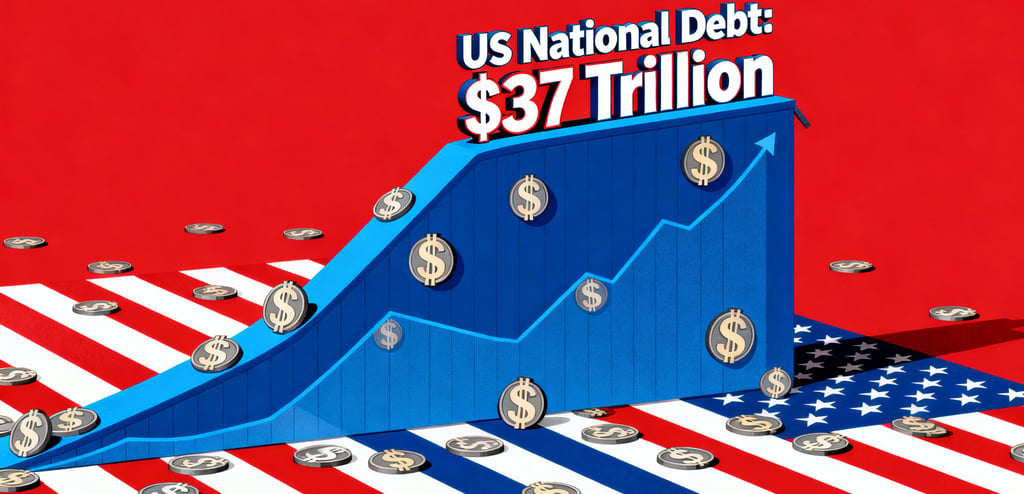
Why the $37 Trillion US Debt Matters: Global Impact & Smart Investing for Indians
The US national debt has soared to an unprecedented $37 trillion in 2025. While staggering in itself, the effects of this debt mountain reach far beyond American borders—causing ripples in financial markets, geopolitics, and personal portfolios worldwide. Here’s what you need to know and how Indians should plan ahead.
Why Does the US Debt Matter?
The US borrows heavily by issuing Treasury bonds. As its debt swells, it must offer higher interest rates to attract buyers, driving up costs for borrowers everywhere—governments, firms, and households.
Faith in the US dollar underpins global trade and investment. If that confidence weakens, currencies, commodities, and capital flows worldwide can turn volatile.
Interest payments alone are expected to soar above $1.2 trillion per year, straining fiscal policy and potentially limiting the US government’s response to future economic crises.
Global Shockwaves: Effects on Bond Markets, Crypto, and Bullion
Bond Markets
Higher US debt means more supply of US Treasury bonds and less appetite among foreign investors, leading to elevated yields and price drops.
This bond market volatility spills over globally: borrowing costs rise in emerging economies, central banks re-balance reserves, and safe-haven demand surges during uncertainty.
If credit rating agencies lose faith, a US downgrade can trigger panic selling, impacting banks, funds, and even pension systems worldwide.
Crypto and Digital Assets
Fears of dollar debasement and debt-driven inflation have buoyed interest in Bitcoin and other cryptocurrencies, especially as alternative stores of value.
If the US dollar dominance erodes, some nations and investors may look to digital currencies for diversification and as protection from fiat currency weakness.
However, regulatory risks and price volatility in crypto remain significant, so these aren’t “safe havens”—they’re speculative hedges.
Bullion (Gold & Silver)
Demand for gold has surged, with prices reaching record highs (above $4000/oz in 2025), as investors hedge against US fiscal instability and dollar depreciation.
Global central banks have decreased US Treasury holdings, redirecting reserves into gold and other hard assets.
Bullion remains a proven portfolio hedge against inflation and currency risk in turbulent times.
How Should Indians Plan Investments (2025-2030)?
1. Diversify by Asset and Geography
Allocate portions to global equities (US, Europe, emerging markets) but with a wary eye—avoid overexposure to dollar-denominated assets.
Consider Indian equities and government bonds, especially as India is likely to attract more capital fleeing US and Chinese risks.
Include international gold ETFs or sovereign gold bonds for crisis-period hedging.
2. Increase Gold Allocation
Gold remains a robust inflation and currency risk hedge. Increase allocation (maybe 10-15% of portfolio) through gold ETFs, sovereign gold bonds, or physical gold.
3. Explore Crypto, Cautiously
Crypto can act as a diversification play, not a core holding. Small allocations (under 5%)—preferably via regulated platforms—can offer upside if global fiat trust declines.
4. Focus on Domestic Growth Sectors
Defensive Indian sectors (FMCG, healthcare), PSU banks, and infrastructure can benefit from both global uncertainty and local policy pushes.
Real estate and REITs may also provide inflation-hedged returns with India’s urbanization trends.
5. Maintain Liquidity and Risk Management
With global uncertainty high, keep ample emergency funds in liquid products.
Limit leverage and speculative bets. Review asset allocation annually.
Final Thoughts
America’s $37 trillion debt pile is more than just a headline—its knock-on effects may shape the global investing landscape for years. For Indian investors, the challenge is also an opportunity: to diversify wisely, increase exposure to real assets like gold, cautiously explore crypto, and bet on India’s long-term growth story while shielding portfolios from global shocks.
Stay informed, stay diversified, and review your portfolio regularly to thrive in a changing world.
Help
Questions? Reach out anytime.
reachus@69waystoinvest.com
© 2026. All rights reserved.
Our Team-
Shrinivas B(MBA)
Ravi (MBA)
Prasad (Mcom)